
Something Else Entirely
Our long and loyal relationship with dogs.

Dogs are cunning geniuses.
They live inside our homes where they’re served nutritious food. We encourage them to sit on the most comfortable furniture. We tend to their health, obsessively groom them, and make sure they have plenty of exercise and enriching activities and warm clothing. We teach them things. And we worry about them when they’re alone.
It doesn’t occur to us that dogs are animals at all; they’re something else entirely.
Would you open your door and allow a raccoon to come inside and eat out of a bowl on your kitchen floor? No, you would not. But dogs occupy a special place in nature’s pantheon; they have risen above every one of the 2.16 million described species on earth, and have attained the distinction of the most favored creature. (Yes, more than cats.) And I think that many people would adamantly tell you that they love dogs more than they do humans. I am one of those people.
My abiding love for dogs isn’t something I can put into words. Could I tell you how oxygen makes me feel? Or gravity? Dogs are a fundamental part of my life; I couldn’t tell you where I end and they begin.
I’ll leave it up to the evolutionary biologists (aka chat GPT) to tell the real story of how dogs got into our houses. I have my own version:
There’s a meager fire. A beleaguered cave family is cooking grizzled meat bits over the low flames. The night is cold and life is hard. A wet snout appears. The cave girl sees the dog’s big round eyes pleading for a scrap. She sneaks him a bone and is rewarded with a nuzzle. The cave boy sighs when he scratches the dog’s soft ears and furry belly. The cave mom notices how well the dog licks the greasy crap off of her pelt. And the cave dad sleeps soundly for the first time ever with a warm dog tucked behind his knees. Suddenly, life isn’t so hard.
The word to describe this process is domestication. But who is domesticating whom?
The dog’s super power is to help us think beyond ourselves—beyond our meager fires and cold nights. They nudge us away from the abyss of human loneliness and allow us to think of ourselves as something else entirely; as people who matter. The unconditional joy of companionship that dogs provide is a primo evolutionary hack to have, as species go. It makes them invaluable, like oxygen or gravity.
And 40,000 years after they first made goo-goo eyes at us, these cunning (and deserving) geniuses have become a $500 billion global industry. I’m an eager participant in that marketplace.
There are dogs who keep us company—worthy recipients of the kibble and grooming and outfits—and there are dogs who change lives.
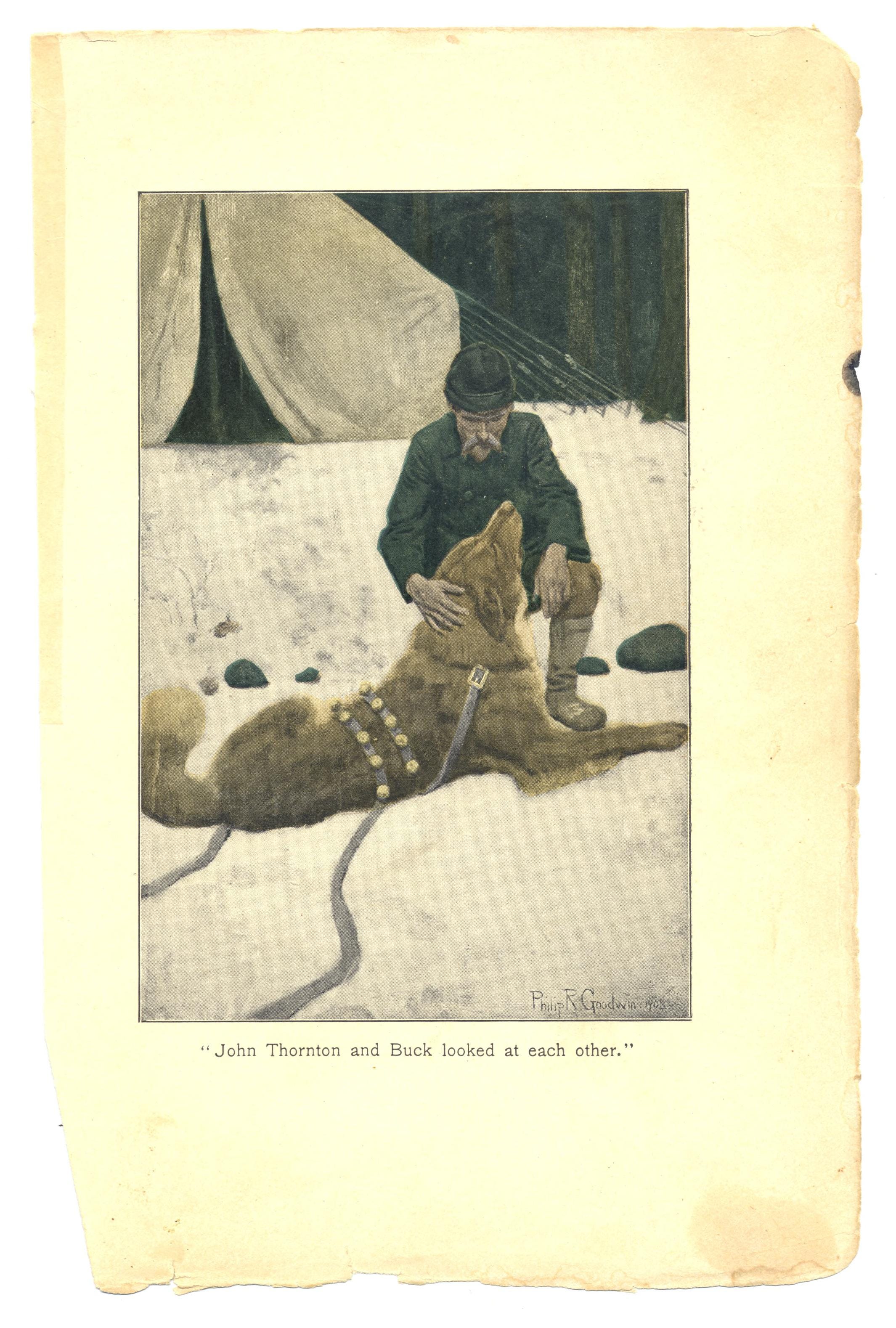
Jack London wrote about one such dog in Call of the Wild named Buck. I remember reading this book in middle school and crying uncontrollably. The story is s doozy: Buck is a beloved family farm dog. He’s strong, wise, and loyal. Swoonworthy! Early on in the story he’s kidnapped, beaten, and dragged to the Yukon. By the end of the book he finds his true strength; he’s re-wilded and finishes out his heroic life unencumbered by the trappings of domesticity. Finally, a real dog.
I still can’t fathom the end of this book. (I can’t get past the word “kidnapped” without a breakdown.) But London was writing about the true character of a particularly amazing specimen by writing him in reverse. Buck de-evolved, so to speak, so we could understand where his magnificence actually came from: nature. The spoiled dog who had snoozed on the front porch of the family farm was, in fact, an animal.
And when, on the still cold nights, he pointed his nose at a star and howled long and wolflike, it was his ancestors, dead and dust, pointing nose at star and howling down through the centuries and through him.
Call of the Wild, Jack London (1903)
I’ve been taking stock of my own strong, wise, and loyal sheepdog, Auggie, who died just before Thanksgiving. That sentence was hard to write. It’s hard for me to admit to myself that he is gone. I’d rather imagine that his enormously fluffy self is just in the other room, snuggled with one of my boys, or stretched out on his favorite spot on the front porch, looking over the neighborhood and all the children and dogs who pass by.
I couldn’t have known how much I needed him when he poked his wet snout into my family’s life. His particular cunning genius was one that I lack: the ability to herd. Having a dog by my side to round up my four boys, well, it made me the luckiest shepherd in the world. I simply couldn’t have done my job without him. But he was more than that. An emotional bedrock; a higher being. A saint.
The truth is, even after 40,000 years, can we begin to put a finger on this profound relationship? To try to describe Auggie would betray the depth of my respect for him; I know that the true understanding of a dog is one that is wordless. Incomprehensible. We connect ourselves to these living beings who don’t possess language, which means that most everything we try to explain is either the superimposition of a human story, or a paltry attempt to get to the deeper meaning: the meaning that goes beyond words.
Jack London did his best to write a book with a dog as the protagonist. Commendable! But when I re-read Call of the Wild, I realized that he was really just writing about what it would feel like for a man to be re-wilded; forced away from the trappings of domesticity and set into the wilderness. Put to nature’s test. An old trope—the idle fantasy of a late 19th-century bruh.
I suppose I’ve always known that we are connected to dogs; they are part of our pack, and we are part of theirs. It’s culturally acceptable for them to sit on our comfy couches, and it’s not weird when we speak on their behalf with silly voices. But Auggie helped me realize a more profound truth: we’ve evolved alongside each other. As species, we are inseparable; without them, we’d be something else entirely. In fact, I’m convinced our sad lot would have petered out thousands of years ago if we hadn’t fallen for their irresistible selves.
Who cares how much money we fork over to “Big Dog,” we’re hopeless without each other.
But perhaps “domestication” is the wrong word to describe this dynamic. I believe there is a re-wilding taking place, although not the one Jack London wrote about. It isn’t happening to the dogs, it’s happening to us. The humans. Dogs may be the last connection to our primal selves that we have. Denying us the crutch of verbal explanations and tiresome rationalizations, dogs force us to come to terms with the fact that we, too, are animals who wear outfits and live in houses. Beneath the trappings, we’re just creatures around a meager fire. We are together on this lonely planet, and still need each other’s companionship to survive.
And perhaps that’s why, instead of all of these explanations and rationalizations about the loss of my dear, dear dog who I miss in a way that’s impossible to explain, I should acknowledge my grief in the only way that’s appropriate in the span of this ancient relationship: in a long, mournful howl.
Let me know your thoughts on dogs, dog outfits, and your take on our wordless co-habitants. And if you like what you read, pass this along! Or hit me up with some ❤️. xox
Dogs. They’re elemental. And the bridges of love between us are tangible.
This is a stunning piece of writing, and encapsulates precisely my feelings for the dogs I have lived with in my lifetime.