
What Eve Saw
A peak behind the fig leaf

Bible stories give me the creeps.
Having no formal religious education, Bible stories have managed to make their way into my brain by osmosis: through references in every kind of literature, rantings of bearded wackos on street corners, haphazard holiday explanations, or – more likely – episodes of The Simpsons. I know Bible stories the same way I know Taylor Swift songs; they’re pervasive enough that I can recognize them when I hear them, but I’ve never sought them out deliberately. (Sorry Swifties!)
The creeps come because of my position as an outsider and a skeptic. My usual response to Bible stories is: are people actually expected to believe this stuff?
As you might have gathered, this loose affiliation makes me a lousy Biblical scholar. And yet there’s one story that gets under my fig-leaf-covered skin, probably because — as silly as it is — it impacts my life on a daily basis.. You know the one: with the apple and the snake and Eve’s naughty ways? The one that has justified the subjugation of women for millennia? That one.
Scholar or not, I consider myself a lifelong expert on this particular creepfest. And frankly, enough is enough.
Stay off the trees!
The story goes that Adam and Eve wandered around in their little terrarium of happiness; naive, perhaps, but bored out of their skulls, I’d bet. I picture Eden as something like the Opryland Hotel in Nashville: a dome-covered, post-apocalyptic naturescape. It’s humid and airless, with bleachy-smelling fountains, fake plants, and plenty of benches to sit on in case you need to stop for a cigarette every 10 feet or so. Anyone in their right mind would look for the exit ASAP. The couple of days I was there, I was so sick of eating fried food that I was tempted to forage in the tropical fakery.
By the time Eve saw the infamous tree with the gorgeous fruit, well, what was she supposed to do?
We all know what happened next. She failed to read the clearly-marked sign: Do Not Climb Tree of Knowledge! Management Cannot Be Held Responsible! She succeeded at grabbing something enticing (An apple? A fake coconut?), she took a bite, and the alarm sounded. But even before the all-caps LORD saw the whole thing from the security desk, and even before she gave a bite to Adam, there was one clear, shining moment when Eve saw something.
An omen? A red flag? What did this rib-derived creature see from up on that branch, chewing away on whatever unidentified fruit the careless authors wrote into this story? Dropped into the garden as a “helper” to Adam, someone he would “cling to,” to become “one flesh” with, she must have seen something. Sheesh! Eve didn’t know from work-life balance yet, but this is a story we know all too well, ladies, amIright? The cards were stacked against her. The all-caps LORD didn’t want her to have wisdom — he lied to her that she would die if she did — but she had it anyway, by herself, for that one clear, shining moment.
The eyes of both were opened, and they knew that they were naked. And they sewed fig leaves together and made themselves loincloths. Genesis 3:7
Are you gonna wear that?
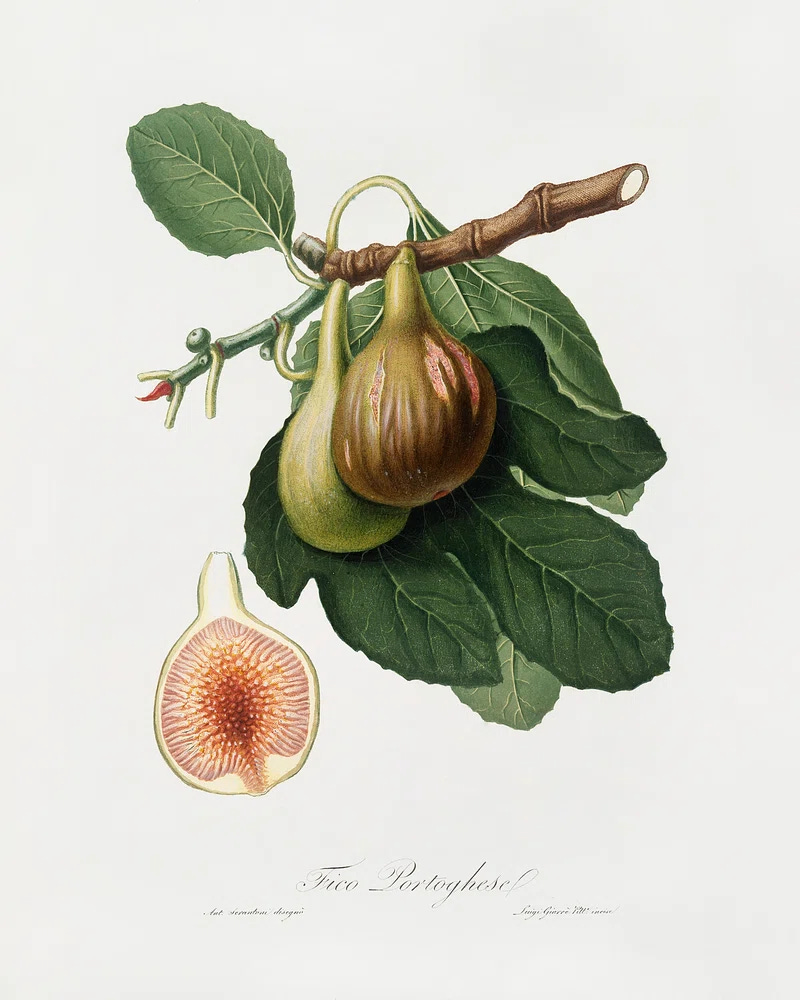
In terms of Western culture, the fig leaf is the OG artifact. Once those two lovebirds realized they were in the raw, they got to work — lo and behold, fashion was born. The earliest art form! Fig leaf (the fit) is the first thing made by human hands, mythologically speaking. It’s a testament to our early industriousness! Tailoring would come later, but in those first moments, I’m sure a bespoke leaf or two was just what they needed. It must have been a relief to have a loincloth, especially with the all-caps LORD dropping by any old time like a neighbor on a sit com.
2,000 years after the incident in Eden, it seems the indecency laws still follow “the fig leaf principle”: we promise to keep our bits covered just enough to keep anyone from taking offense. In other words, we need to wear just enough material to cover up a couple of fig’s worth.
Really, it’s genius. And sustainable!
Also, I hate to break it to the authors, but they really fall short on motivation in the shame storyline, especially where husbands and wives are concerned. Call it a dramaturgical fine point, but if there aren’t any towels in the bathroom, I don’t see any modesty in my house on the way to the linen closet.
The man said, “The woman whom you gave to be with me, she gave me fruit from the tree, and I ate.” Genesis 3:12
Once a tattletale always a tattletale
It’s not surprising that Adam threw Eve under the bus about the forbidden fruit. And it’s not surprising that the all-caps LORD felt that Adam should “rule over” her because of it. It’s totally on brand for those Old Testament bruhs. Eve saw all that coming, and she wasn’t scared. Puh-lease!
But in their shameless, misogynistic power grab, the authors left out something essential when they concocted this story. For me, it’s the only thing that makes the story makes sense— as something someone could believe in. It’s what Eve saw from up in that tree: when she looked down at Adam, she zeroed in on him with newly acquired x-ray vision and saw that guy for exactly who he was. Some might call it wisdom, I call it a survival skill.
Every woman who has ever lived on earth knows exactly what I am talking about.
The ability to see men for what they are is is the superpower that has kept the entire human race alive, despite the violent and manly mythology to the contrary. It also helps explain the reason that bible stories are so creepy to me: they’re so flagrantly unaware of what women actually know. It makes them sound so silly.
And it also helps explain the reason for the fig leaves. On that auspicious day back when Eve got the hell out of that miserable, stinking terrarium, she very cleverly figured out how to get her husband to put something on.
Nobody — and I mean nobody — wants to see their husband walk around naked.
Well? Weigh in! Tell me … how do we make sense of this old chestnut?
And thanks for reading. xox
Thank the all caps LORD the bath towels in our house are bigger than a fig leaf.
Your writing never disappoints.