
The Enemy is Not Within
Any plans for Loyalty Day?

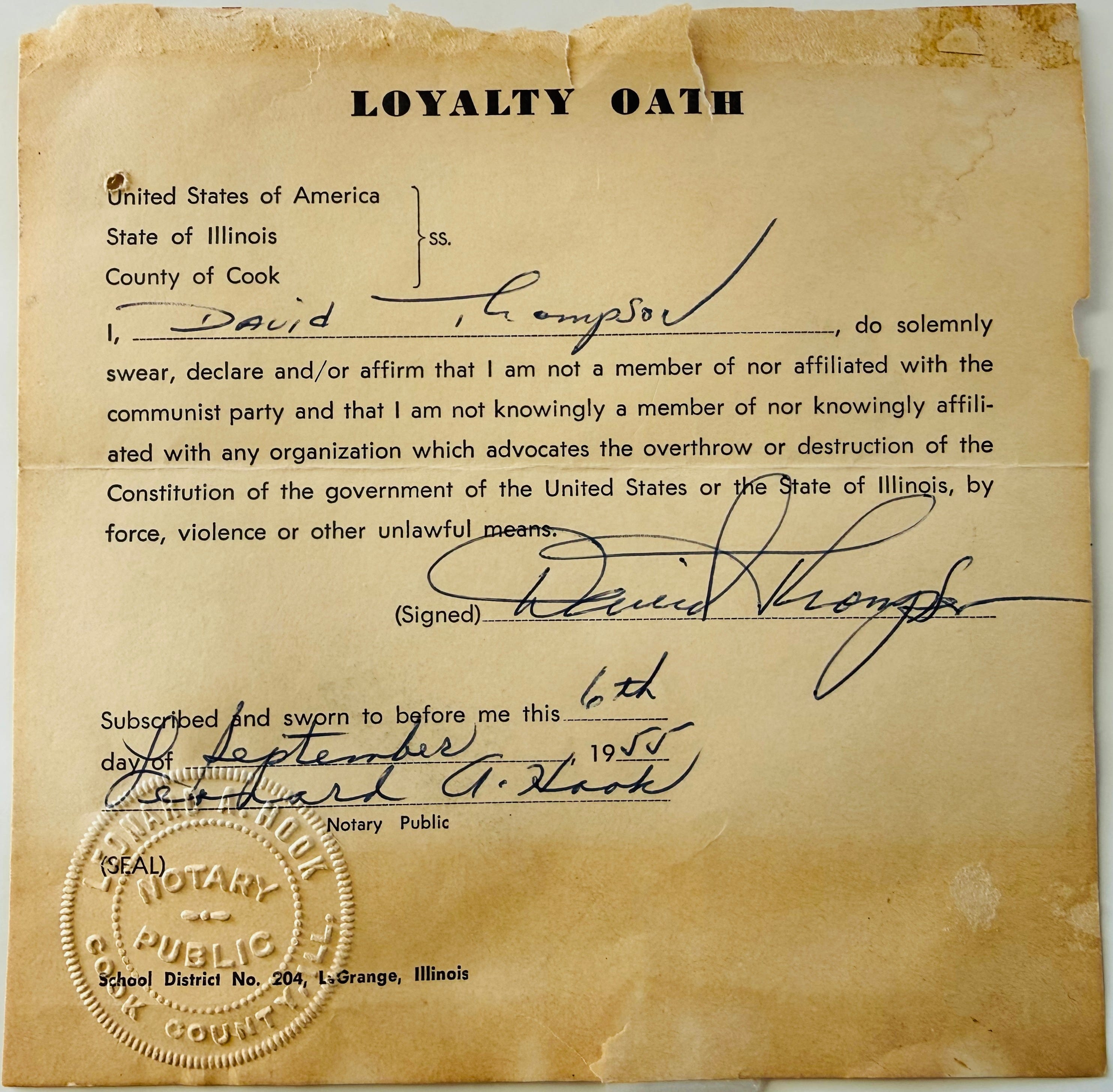
My parents weren’t big on saving things; there was nothing of value in our house to save. The odds and ends they left behind are purely sentimental: a cookie jar, a puppet with no body, some wooden birds carved by my grandfather. In lieu of heirlooms, my father collected strange artifacts for the six of us. Think of a box big enough to hold a dress shirt from Lord & Taylor, and that’s what held the personal collection from my entire life as the sixth child. The box doesn’t contain normal things. It’s weird stuff: the ugly pair of glasses I wore in third grade, an old barrette, and a conspicuous number of letters home from teachers who complained about my desire to talk to my neighbor.
But the document above — my father’s signature proclaiming his allegiance to the United States — is one of the more consequential odds and ends that he saved. Tucked away for many years, it was unearthed long after he died. This abject relic from the 1950s fell out of an old book.
At first glance, it’s just a yellowed piece of paper. Signed and notarized on September 6, 1955. But I can tell by the way he drilled the ball point into the paper, swooshing the loops of the D and the T with obvious force: he was pissed.
My father wasn’t a communist. He had no intention of overthrowing the Constitution of the United States. But I’m positive that when he signed this oath, he did so with his fingers crossed behind his back. And I’m fairly certain he muttered “bullshit” under his breath. Or maybe he wasn’t so subtle; perhaps he let the Notary Public in on his displeasure. Maybe they shared a “Can you believe this fucked up shit?” eye roll between them. It would have been impossible for my dad not to say something.
But he signed because he had no choice. In Illinois and elsewhere, it was the law. If he hadn’t completed this asinine errand on that September day, he would lose his job.
“School teachers are the advance guard of our freedom. Our future depends on their fidelity. It is vital that our youth cultivate and retain a firm belief in the American ideals.”
Judge Julius Miner, Cook County Circuit Court
That September, my dad was beginning his second year teaching English and Stagecraft at a high school in LaGrange, Illinois, the town where I grew up, just outside Chicago. He was 28 years old. He wore a bowtie. If he had on a soaking-wet overcoat and 98 dollars worth of coins in his pockets, he would have weighed a scant 130 pounds. He was non-threatening by nature; a theater guy who had barely left his home state of Wisconsin (except for a stint in the Navy during WWII), he looked every bit the ingénu. But behind his boyish exterior, he had other ideas about the way things should be.

About the time my father was in college at UW-Madison, another Wisconsinite, Senator Joseph McCarthy, came to office as a populist — hell bent on taking down elites. Although it took him a few years to hit his stride, in February of 1950, he hit a nerve. He claimed that the State Department was “thoroughly infested with communists.” His flair for theater was apparent, he even brought props.
“I have in my hand 57 cases of individuals who would appear to be either card-carrying members or certainly loyal to the Communist Party, but who nevertheless are still helping to shape our foreign policy.”
Senator Joseph McCarthy
The lies he waved around were immaterial. For a country who had lived through two world wars, this was a the-call-is-coming-from-inside-the-house moment. McCarthy called it “the enemy within.” But actually, the enemy was anywhere he pointed his finger.
Names contained nuclear potential. One utterance of communist association was enough to detonate a string of reactions; hundreds were blacklisted, thousands lost their jobs. Innumerable lives were ruined. Chief among the collateral damage were writers and directors in the entertainment industry, academics, and labor activists. All accused of communist subversion.
At the center of this dystopian performance — 188 hours of which was televised live to 20 million daily viewers — were the center-stage wheezings of Joseph McCarthy as Othello, and his henchman and Chief Counsel, Roy Cohn, as Iago. The duo shared a knack for freaking people out. Hot off his success back-channeling the executions of Julius and Ethel Rosenberg, Cohn’s only challenge was making sure he didn’t upstage the lead as he plotted his own destructive future.
“Gradually, all the old political and moral reality had melted like a Dali watch. Nobody but a fanatic, it seemed, could really say all that he believed.”
Arthur Miller
As a culture, we carry around many slick-backed ideas about the 1950s: it’s all poodle skirts and Fonzie nostalgically sock-hopping away. The reality is an embarrassing contrast. Fortunately, it doesn’t take much to wipe the Brylcreem from our eyes and see it for what it is. For me, that’s thanks to Arthur Miller and his 1953 play, The Crucible — a real-time response to the McCarthy hearings. Although Miller would later write that conceiving of a play about this era was “like trying to pick one’s teeth with a ball of wool,” it’s lucky for us that he kept picking.
Maybe you read it in high school, maybe you saw a community theater production, or maybe your world was rocked by Nicholas Hytner’s 1996 filmed adaptation (starring the positively dreamy Daniel Day Lewis as wrongfully accused John Proctor). Miller’s 17th-century story of the Salem witch trials did more to elucidate the 20th-century Red Scare than any history book ever did.
To recap: Girls go into woods. Girls dance in woods. Girls get into trouble. Girls freak out. Town freaks out. Girls lie that people are witches in order to get out of trouble. People are hanged for no reason.
OK, that was a gross misrepresentation of Miller’s dramatic tour de force. It’s a real story about real mass hysteria — both in Salem and in Washington — and what happens to the truth when fear is used as a cudgel. The Crucible was produced at the height of McCarthy’s madness, and received meh reviews (from my POV, it sounds like the director was a dud). But I think it’s safe to say that people weren’t ready for it. The public was still riveted by the grainy black and white version of the Washington witch hunt, the season finale of which was still in production.
“Thou shalt not suffer a witch to live.”
Exodus 22:18
The Old Testament did an amazing job planting landmines for the paranoid — the Thou Shalt Nots read like The Ten Habits of Highly Suspicious People — and we continue to trip these mines daily.
Take May 1st, for example.
To many people here and around the world, May 1 is International Workers Day. It was started in 1884 by the Federation of Organized Trades and Labor Unions with the proclamation: “Eight Hours for Work, Eight Hours for Rest, Eight Hours for What We Will!” It was a day to commemorate hard won right of a reasonable day’s work — and so much more, despite the bloodshed that followed.
But by the time President Dwight Eisenhower came along, May Day had taken on a socialist ring – if only because being pro-worker was the equivalent of being a communist. So, in April 1955, old Eisenhower (the same guy who put “under God” into the pledge of allegiance, and who sat back while Joseph McCarthy ran roughshod over justice) commandeered May 1 as a day to get all patriotic – and eclipse the worker’s rights holiday. To all commie haters, this day would forever be known as “Loyalty Day.”
Whereas it is fitting that a special day be set aside for solemn re-evaluation of those priceless gifts of freedom which are our heritage, to the end that we may stimulate and renew that high sense of patriotism which has signalized our glorious history as a Nation.
Proclamation 3091—Loyalty Day, 1955
Eisenhower’s invigoration of Loyalty Day put pressure on states to pass loyalty oath requirements — like the one my dad signed. The law that passed in Illinois that summer required him to show up for the school year with the oath in hand.
But, even though there might not be sales on appliances on May 1, Loyalty Day did not end. Enter Donald Trump — the most histrionic upstager of all time — who has his own take on Loyalty Day.
For authoritarians, loyalty is everything. So naturally, May 1 has become a day to triple down on pledging allegiance — to Trump. Throughout both terms, he’s used this day to demand patriotic fealty. None of this is surprising, given that Trump’s formative shithead skills were learned at the knee of Roy Cohn himself, one of the all-time worst shitheads.
But Loyalty Day in MAGA-land is real, and the anti-communist DNA of Loyalty Day remains strong. The most recent proclamation commands all of us to hang a flag, reflect on the rule of law, and asks us to consider the “innumerable people across the world currently under captivity by communist leaders.”
I believe we’re living under captivity right this second.
But as with witches, so with commies — and so with liberals. To root out evil, true loyalty is best expressed at other’s expense.
Have you no decency, sir?
Joseph Welch
McCarthy’s Headless Horseman ride through democracy came to an end when he accused the US Army of harboring communists; it was a step too far. McCarthy was rebuked on national television by attorney Joseph Welch who called the entire charade into question — at last. His unchecked power had devolved into 46 counts of misconduct; McCarthy was censured by the United States Senate a few months later in December of 1954 (and he’d be dead in a few short years of alcoholism).
But the damage was done. The Red Scare was far from over.
Unsurprisingly, Arthur Miller was surveilled by the FBI; in 1956 he was dragged before the House Un-American Activities Committee (HUAC - a separate but equally freaked out group of House members), blacklisted, threatened with jail, and denied his U.S. Passport. But Miller’s only regret was that he didn’t have the “temperament” to write The Crucible as an absurd comedy:
“The theater is a serious business, one that makes—or should make—man more human, which is to say less alone. [It involves] real questions of right and wrong. Then I set out, rather implacably, and in the most realistic situations I can find, to search out the moral dilemma and try to point a real, though hard, path out.”
Arthur Miller
When Arthur Miller was asked to name names of writers who attended a communist meeting back in 1947, he said, no can do. His conscience would not permit it. And followed up the resulting threat of Contempt of Congress with: “Sir, I believe I have given you the answer that I must give.”
It was very John Proctor of him.
Loyalty Oaths for teachers, like the one my father signed, continued to be required into the 1970s — but recently, an even more questionable tendril of this story emerged, thanks to Project 2025, the Heritage Foundation’s playbook for the dark arts; they prompted Trump to require allegiance from those entering the federal work force as civil servants. Say you want a job as a Wildland Firefighter, or an Air Traffic Controller, the Office of Personnel Management currently requires answering four essay questions if you want to be considered for “merit pay” (a.k.a. being hired). Here’s Number 3:
3. How would you help advance the President’s Executive Orders and policy priorities in this role? Identify one or two relevant Executive Orders or policy initiatives that are significant to you, and explain how you would implement them if hired.
In March of this year, Federal workers’ unions argued against this requirement in front of a Massachusetts federal judge, claiming it: “creates a patronage model in which loyalists are rewarded with jobs for their political support.” The judge has not yet issued a ruling. But I don’t have a good feeling about it.
John Proctor: I have given you my soul; leave me my name!
The Crucible, Act Four
I can’t know what was on my dad’s mind when he folded this Loyalty Oath in half, tucked it into a book, and slid it onto the shelf in his office where he kept all of his plays. Time went on. Children were born. Then more children were born. He dedicated himself to directing and producing theater — which for my family (in Miller’s words) made us more human, which is to say, less alone. My dad spent a lifetime in pursuit of thinking freely. He was fierce and opinionated, he did not back down. He taught us to do the same.
But I still wonder how he felt that day when he was forced to sign his name.
Given the weird stuff he set aside for me, I believe he hoped we’d find this particularly troubling artifact and think about what it meant. Yes, it’s just a yellowing piece of paper with his indelible signature, but tucking it in that book was his way of asking the future: “Can you believe this fucked up shit?”
On one hand, yes — I believe this fucked up shit all too well. But on the other hand, even with the chaos that continues, I have to think my dad would follow Arthur Miller’s approach, whose plays sat alongside the book where this oath was found: to search out the moral dilemma and try to point a real, though hard, path out.
What are you plans for Loyalty Day?? Any holiday recipes to share? I plan to make a Red Scare Pie (cherry, of course). xox
Imagine what our parents would make of this Trump crap.
I thoroughly enjoyed this piece, Marcy! The mixing of personal and historic relevance is particularly engaging for me, I've learned so much history in recent years! My 'Loyalty Day' 'May Day' was in participating once again, in the national Fall of Freedom day, a call for all creatives for an act of resistance. I had created 5 necklaces, each with a single word spelling out : IF NOT NOW WHEN? With 5 of us wearing them, (most of us you know) together or apart, it has brought an engagement and communication with others who are curious about the piece being worn. A solidarity and sense of community has been the grateful result.