
Sticker Shock
Reflections on affordability.

I’ve been doing a lot of gasping lately.
A family size box of Cheerios: $9.51
A blueberry pie: $45.00
Two chicken breasts: $19.50
One cinnamon donut: $9.00
A cup of coffee: $5.65
Not only does the list above give you a sense of what I like to consume, it’s also an accurate count of what these items cost just blocks away from where I live. Of course, I’d never pay these prices (as my gasps will attest), even if I could; but each day I am more and more bamboozled by how expensive the world is becoming.
Every time I walk down the aisle of a grocery store, or open a menu, or look for a gift, or fill up the tank, I become apoplectic. A human exclamation point. A ranting old lady in a polyester pantsuit declaring the world has gone stark raving mad. It seems that everything has become not just too expensive, but genuinely out of wack. And it’s not just the pricey stuff sold in my pricey town. Over the last few years, I’ve found it progressively more impossible to square money going out with money coming in. Necessities (which in the above list might only include coffee, to be fair) have become unaffordable luxuries.
And I know I’m not alone.
In the US, the top 1% control about one-third of the nation’s wealth – and hold as much net worth as the combined bottom 90%. $9 donuts are the only kind of donut they want! These types doing so well, and spending so much, that the dismal economy that’s literally killing the rest of us looks like it’s chugging along at a healthy clip.
“Affordability” — the buzz word of campaigns and of greedy reality-deniers — is the funhouse mirror of our current culture: it looks like different things to different people. Even if everybody agrees that a $9 donut is expensive, somebody’s buying them; others may wish they had that $9 to pay for their medication. Perhaps affordability is a misnomer, perhaps it’s not a strong enough term. But it’s time we learn how to accurately talk about the vast impoverishment being perpetrated on our county — both in terms of income and prices — and the hundreds of millions of lives who are being depreciated right out of the economy.
The overwhelming majority of the country has been factored out, whether we know it or not, rejected in favor of an economic indicator with far more clout: the gross domestic product. This is the rate at which we accumulate material things. It’s about stuff. No matter if all of it will end up in a Bagster on the curb (the suburban preference), or as part of a plastic reef of ocean garbage. The “gross” in GDP says it all.
Yet the gross national product does not allow for the health of our children, the quality of their education or the joy of their play. It does not include the beauty of our poetry or the strength of our marriages, the intelligence of our public debate or the integrity of our public officials. It measures neither our wit nor our courage, neither our wisdom nor our learning, neither our compassion nor our devotion to our country, it measures everything in short, except that which makes life worthwhile. And it can tell us everything about America except why we are proud that we are Americans.
Senator Robert F. Kennedy, March, 1968
If you’ve seen the UFC fight cage under construction on the White House lawn, you’ve probably also seen the depressing shade of “American flag blue” being painted on the bottom of the Capitol Reflecting Pool. It’s as if Vince McMahon took over our nation’s capital and turned it into a WWE theme park. D’Trump may think he’s appealing to a red-blooded demographic of (imported) patriots, but I happen to believe that the current attempt to flagwash the pain and suffering of the American people is going to require a lot more than selling corn dogs on the National Mall.
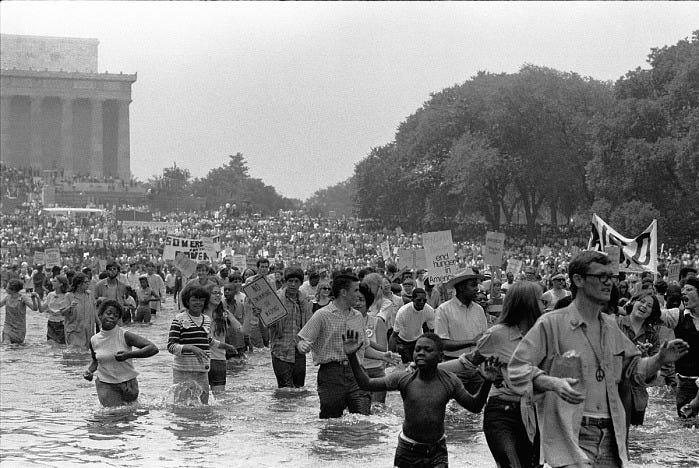
The photo above — captured 58 years ago in June, 1968 — tells a different story in the same space.
This image was taken by Canadian-American photographer Laura Jones, on what was called Solidarity Day. As many as 50,000 people had gathered around (and in) the Reflecting Pool on that hot summer day, the result of a weeks-long encampment called Resurrection City: thousands of tents and temporary wooden structures that made up a town-sized protest against poverty that could be seen and felt by lawmakers in Washington, DC. If elected officials weren’t familiar with what economic inequality looked like, economic inequality would come to them. This six-week occupation was the brainchild of Reverend Ralph Abernathy of the Southern Christian Leadership Conference, and Dr. Martin Luther King, Jr.
“This will be no mere one-day march in Washington, but a trek to the nation’s capital by suffering and outraged citizens who will go to stay until some definite and positive active is taken to provide jobs and income for the poor.”
Dr. Martin Luther King, Jr., December 1967
As part of the Poor People’s Campaign that sought to cross racial and ethnic boundaries with the common mission of lifting US citizens above the poverty level, Resurrection City galvanized many thousands of disenfranchised people. They came from all over the country, lived together, and spoke together on a national stage, demanding federal funding for full employment, a guaranteed annual income, anti-poverty programs, and affordable housing.
The haze of that day is palpable in this photo. The thigh-high water probably offered little relief, but the energy is there — the humanity of shared experience — despite the high temperatures, and five weeks of mostly rain, going on six.
It was a moment of high visibility for a group of people called by the term that best described them: poor. The potential stigma of poverty was not of concern; the power of “poor” was in the enormity of its numbers. In 1968, 19% of Americans (35 million people) lived below the poverty line — Black Americans were three times as likely as other groups to live below the poverty line. An astounding number. Today, we might take issue with the term “poor” as an undifferentiated mass. But for the Poor People’s Campaign it was the element that brought sometimes disparate groups together under one apolitical heading. Poor included everyone.
The “war on poverty” declared by Lyndon Johnson a few years before found a foothold with the work of MLK and Rev. Abernathy; the Poor People’s Campaign was also supported by Senator Robert Kennedy, who sent word to Dr. King to “bring his people to Washington” when the plan was first hatched. Resurrection City was the outcome of years of civil rights-related organizational might that had increased steadily since the March on Washington for Jobs and Freedom in 1963.
But Martin Luther King was assassinated just weeks before the first tent was raised at Resurrection City. And Robert Kennedy was assassinated just three weeks into the occupation. His funeral procession stopped in Resurrection City on the way to Arlington Cemetery. The momentum of the Poor People’s Campaign had wavered, but the efforts were not in vain.
“It was in our wallowing together in the mud of Resurrection City that we were allowed to hear, to feel, and to see each other for the first time in our American experience.”
Rev. Jesse L. Jackson, Mayor, Resurrection City
Bear with me while I work through a few numbers:
11.1% of Americans currently live below the poverty line – nearly 37 million people – a slightly higher number than 1968.
Accounting for inflation, $100 spent in 1968 is now $957.
The current federal minimum wage is $7.25/hour.
As of this month, the federal minimum wage has been unchanged for 17 years.
If the minimum wage had kept pace with productivity since 1968, advocates estimate it would be $24/hour
Since the federal minimum wage was raised in 2009, corporate profits have increased 240%.
Last week, The Brookings Institution released the first in a series of grim reports: “States of Affordability: a series on why and where US households struggle to make ends meet.” Guess what? They aren’t. In 2024, 45.5% of US households did not earn enough to cover basic needs — make that number 55% for households of color. These are items like food, medication, and rent. Not $9 donuts. Stagnant wages, inflation, and a couple of centuries of policies designed to fuck over lower and middle class people all boil down to one thing: the economy is going to make the vig any way it can.
Call it affordability, call it making ends meet, call it being stuck in the shitter — the economy is not working for almost anybody. The Poor People’s Campaign in 1968 helped bring the conversation on poverty forward, and humanize the struggle of those impacted. But it didn’t have nearly the impact it should have.
In our current era of idolizing oligarchs, can we expect mercy? How can we hope to find policy solutions in the face of outsized greed? The smallest gesture of corporate compassion seems impossible when self-dealing billionaires hold the reins on our ability to make money, or afford necessities.
But the groundwork for change has been laid.
On that hazy Solidarity Day, June 19, Coretta Scott King made a stirring speech to the 50,000 people gathered at (and in) the Reflecting Pool. It was Juneteenth. She said this:
“Too long have we uttered pious platitudes and made faulty promises to our less fortunate brothers. Our destiny is tied up with their destiny. And we are being forced to place the issues where they belong: squarely on the conscience of the American people.”
Coretta Scott King
In the spirit of the Poor People’s Campaign, if we can’t bring the oligarchs to witness economic inequality, let’s bring economic inequality to them. How? We place the sticker below directly on their conscience.
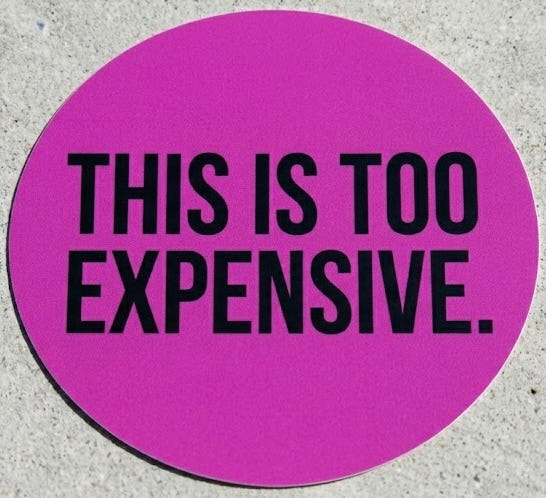
Imagine being armed with a roll of these stickers, and leaving behind a succinct, well-placed message at Target, restaurants, grocery stores, or the gas station. “This is too expensive” on a family sized box of Cheerios is more than a boycott, it’s a statement you can share with others; a collective action that calls out the shrinkflation, the price gauging, the hideous greed that hobbles all of our families and counts us out in favor of the all powerful GDP. Don’t want to wait to let a survey know you’re unhappy with the economy? This sticker says something.
A roll of stickers is definitely not as eloquent as Coretta Scott King. But a trip to DC to witness a cage fight — or the National Mar-a-Lago pool — is out. I don’t have the stomach for it. The funhouse mirror that we’re all living in will continue to warp our realities depending on the nearest oligarch, but I’ll do my best to keep this photo of Solidarity Day in mind. Not as a sad chapter with an unsatisfying ending, but as a way to meditate on hope and to be inspired to make change. That is what reflecting pools are for.
So, whaddya say? Want some stickers?
Thank you for reading, sweet reader! What’s the craziest price you’ve ever seen? (Mine was $40 for a box of hand-dipped Hanukkah candles). And how would your life better if you could make ends meet?
Love the stickers. How do I put one on the overpriced (but delicious) pies down the street?
What an excellent and educational piece. I was around 5-6 when this took place so it was fascinating to learn what transpired. Thank you for your writing!